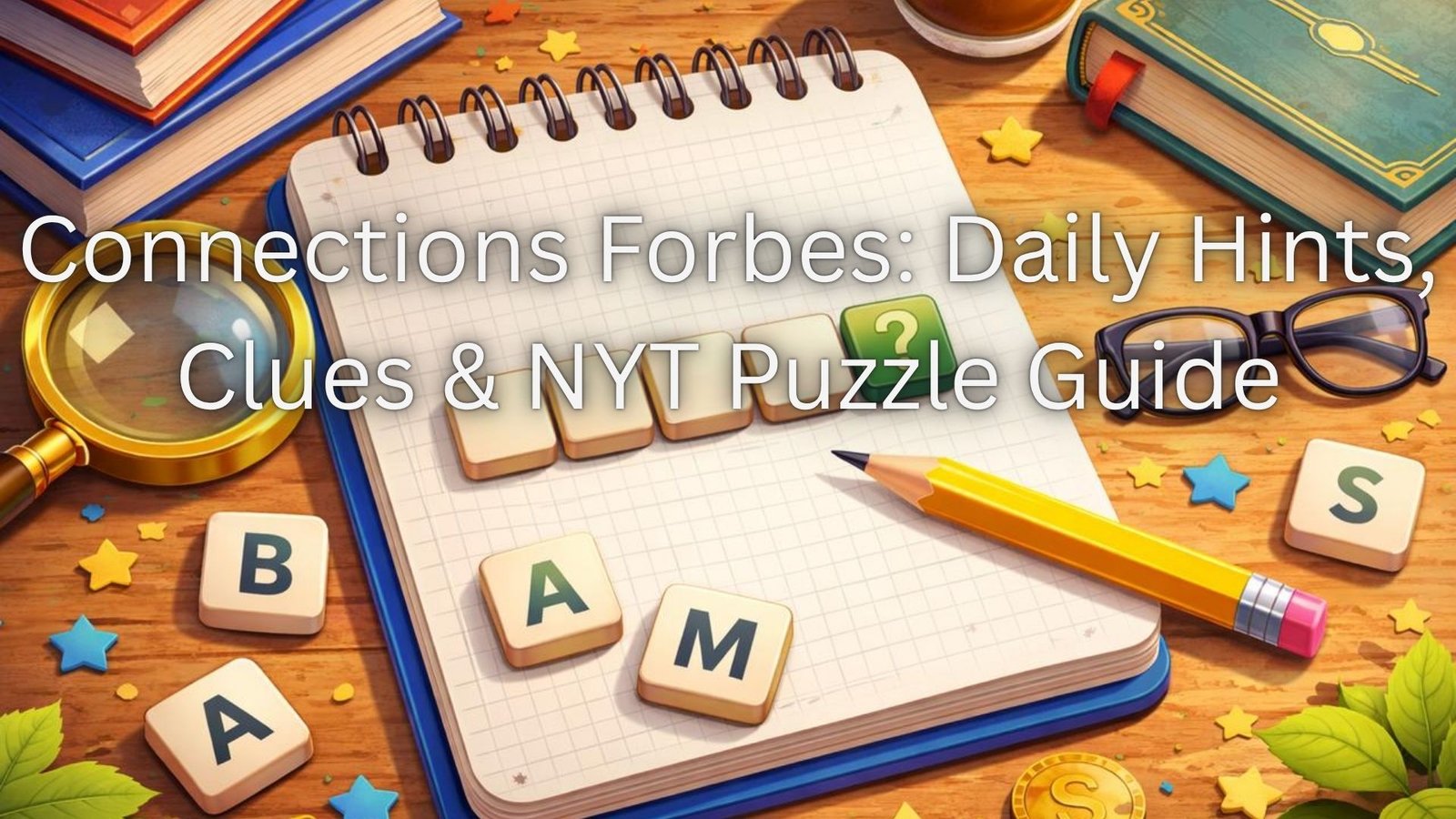
Connections Forbes: Daily Hints, Clues & NYT Puzzle Guide
You opened today’s NYT Connections puzzle. You stared at sixteen words. And now you’re stuck. That’s exactly why so many players search for Connections Forbes every single morning.
This guide covers everything you need. You’ll learn what Connections Forbes actually means, how the daily Connections hint system works, and how to use spoiler-free hints the smart way. You’ll also pick up real puzzle-solving strategies that make you faster at the NYT word puzzle, not just today, but every day after.
What Is Connections Forbes?
Connections Forbes refers to the daily articles Forbes publishes to help players solve the NYT Connections puzzle. These posts give you Connections hints, category hints, category names, and eventually the complete answers. You choose how much help you want.
Most Connections Forbes today articles don’t dump every answer on you right away. They build up in stages. First comes a soft nudge. Then a clearer clue. Then the full word groups. This layered approach is why Connections Forbes hints feel less like cheating and more like a helping hand.
Read More About: Tubehalote: Complete Guide to Tubehalote com, Content, Features & Safety
What Is the NYT Connections Game?
NYT Connections is a daily word game from New York Times Games. You get 16 words on a grid. Your job is simple to explain but hard to do: sort them into four groups of four that share a hidden connection.
Unlike a crossword, this game doesn’t test spelling or definitions. It tests pattern recognition. Four words might look random at first. Then you spot the trick, and suddenly they click into place. That “aha” moment is the whole point of the Connections game.
Every Puzzle Contains
Every single Connections puzzle follows the same basic structure. Here’s a quick breakdown.
| Feature | Details |
| Total words | 16 |
| Groups | 4 |
| Words per group | 4 |
| Difficulty levels | Yellow, Green, Blue, Purple |
| Mistakes allowed | 4 |
Each solved group gets a color based on how tricky it was to spot. That color system matters a lot, and we’ll dig into it later in this guide.
How Connections Forbes Structures Daily Hints
Forbes daily Connections hints follow a predictable format. That’s actually the appeal. You always know what kind of help is coming next, so you can stop reading the moment you’ve got enough.
The structure moves from vague to specific. A general difficulty assessment comes first. Then spoiler-free category clues narrow things down. After that, category titles appear. Finally, you get the complete Connections puzzle answers, along with an explanation of the word relationships behind them.
Difficulty Overview
Most guides open with a general read on the day’s puzzle. Maybe the Purple group is unusually sneaky today. Maybe the Yellow group is a gimme. This overview sets your expectations before you even look at the grid.
It’s a small thing. But knowing the puzzle’s overall difficulty changes how you approach it. You’ll spend less time second-guessing an easy group and more time on the one that actually deserves it.
Category Hints Without Spoilers
Next come the category hints, phrased as gentle nudges instead of direct answers. A hint might say “think about cooking terms” or “these all relate to office supplies.” That’s enough to point you in the right direction.
These spoiler-free hints work because they engage your brain instead of replacing it. You still have to do the thinking. The hint just narrows the search space, which is the whole point of using Connections clues instead of jumping straight to the Connections solutions.
Category Names
If the soft hints didn’t crack it, the actual category titles show up next. Seeing a label like “Types of Fruit” or “Parts of a Computer” often makes the grouping obvious in seconds.
This step is the last one before full spoilers. Many players stop here on purpose. It gives you just enough information to finish the puzzle yourself while still preserving the satisfaction of solving it.
Complete Answers and Word Groups
This section is the last resort. It lists every category along with its four complete answers. Use it to check your work or figure out exactly where a guess went wrong.
Treat this section like an emergency exit, not your first stop. Reading the full word groups too early skips past the fun part. Save it for when you’re genuinely stuck or want to confirm a finished solve.
Puzzle Analysis and Explanation
Good guides don’t stop at the answer. They explain the puzzle logic behind each group. Why do these four words belong together? What was the trick?
This puzzle analysis matters more than it seems. Learning the reasoning behind today’s connection explanations helps you recognize similar patterns tomorrow. Over time, that’s what actually makes you a better solver, not memorizing individual answers.
Why Millions Search for “Connections Forbes Today”
People search “Connections Forbes today” because they want a nudge, not a spoiler. Nobody wants the fun ruined by seeing every answer at once. They just want enough help to keep their win streak alive.
A few things drive this demand. The daily puzzle routine builds real habits, similar to Wordle. Some Connections categories lean on obscure cultural knowledge that even sharp players miss. And wordplay can be genuinely deceptive, especially once you reach the Purple group. For a lot of Americans, checking Connections today has become as automatic as checking the weather.
How to Use Connections Forbes Hints Without Ruining the Puzzle
Using hints well is a skill of its own. Think of it like a ladder. Climb one rung at a time instead of jumping straight to the bottom floor.
The goal isn’t just finishing today’s grid. It’s building habits that make every future Connections puzzle easier. Here’s how to do it right.
Start With the General Hint
Always read the overview first. A simple note about today’s difficulty resets your expectations and stops you from panicking over a tough Purple category before you’ve even started.
This step costs you nothing in terms of spoilers. It’s pure context, and it makes the rest of your solve smoother.
Reveal One Category at a Time
Don’t read the whole hint page in one sitting. Solve as much as you can. Check one hint. Go back to solving. Repeat.
This rhythm keeps the challenge alive. It’s the difference between playing the game and just reading the results of someone else playing it for you.
Save the Full Answers for Last
Treat the complete answers section as your final option, not your first click. If you’re truly stuck after trying everything else, that’s when it’s worth opening.
You’ll retain far more problem-solving skill by struggling through most of the puzzle yourself. The answer key should feel like a safety net, not a starting point.
Review the Puzzle Logic After Solving
Don’t stop once you’ve filled in the last group. Read the explanation for each one. Understanding the designer’s thinking is what actually sharpens your instincts for tomorrow’s puzzle.
This step is easy to skip, and most players do skip it. But it’s arguably the most valuable part of the entire process.
Understanding the Four Difficulty Levels
Every Connections puzzle uses the same four-color system: Yellow category, Green category, Blue category, and Purple category. Knowing what each color usually tests makes the whole grid feel a lot less intimidating.
These difficulty levels aren’t random. Puzzle writers design them on purpose, building from obvious to devious. Here’s what to expect from each one.
Yellow – The Most Straightforward Group
The easiest yellow group usually involves direct, literal connections. Think colors, animals, months, or musical instruments. These are the words that jump out at you almost instantly.
Start here. Locking in the Yellow group first builds momentum and shrinks the puzzle down to something far more manageable.
Green – Moderately Easy Connections
The moderately difficult green group takes a bit more thought. Common themes include professions, household items, sports vocabulary, or travel vocabulary. It’s still fairly direct, just one notch trickier than Yellow.
Don’t rush this one. It’s easy to confuse a Green word with something that actually belongs in Blue.
Blue – More Challenging Word Relationships
The challenging blue group often introduces real ambiguity. Words here might plausibly fit more than one category, which is exactly the point. Common Blue themes include famous people, business terminology, historical references, and scientific concepts.
This is where careful reading starts to matter more than quick instinct.
Purple – The Most Difficult and Creative Category
The difficult purple group is where puzzle creators get genuinely inventive. Expect puns, hidden prefixes and suffixes, rhyming words, homophones, and pop culture references. This category is what separates a clean solution from one that burns through all four mistakes.
If a word feels oddly out of place everywhere else, it probably belongs here.
Common Types of Connections Categories
Recurring themes show up far more often than you’d expect, and recognizing them speeds up your solving considerably. Below is a table of the most common Connections categories and example themes.
| Category Type | Example Theme |
| Synonyms | Happy, Joyful, Glad |
| Geography | Countries, Rivers |
| Food | Cooking terms, Herbs |
| Sports | Sports vocabulary |
| Literature | Famous Authors |
| Science | Scientific concepts |
| Music | Music genres |
| Movies | Movie genres |
| Wordplay | Homophones, rhyming words |
| Office | Office-related terms |
| Travel | Travel vocabulary |
| Pop culture | Fictional characters |
Once you’ve solved a few dozen puzzles, these buckets start to feel familiar before you’ve even finished reading the grid. That’s pattern recognition at work, and it’s one of the biggest skills the game quietly teaches.
Proven Strategies for Solving NYT Connections Faster
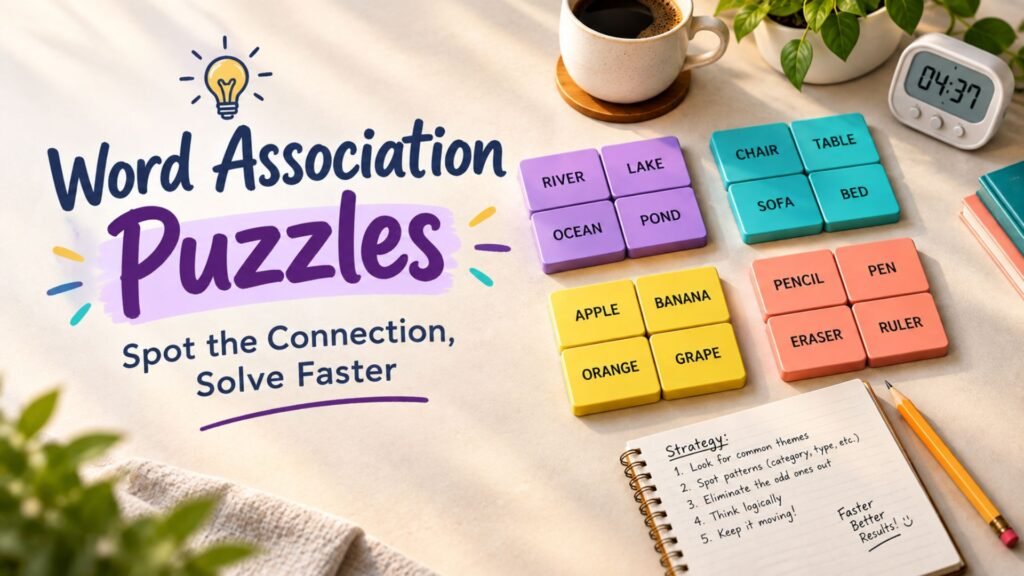
Strong players rarely guess at random. They follow a structured process instead of hoping for a lucky match. These puzzle-solving strategies apply to almost every grid you’ll face.
Below are six tested Connections strategies that consistently improve solving speed and protect your win streak.
Find the Most Obvious Four Words First
Locking in the easy group early builds momentum. Once four words disappear from the grid, the remaining puzzle feels much simpler to read.
Look for Multiple Meanings
Words like bark, pitch, match, and ring carry several multiple meanings. Puzzle writers love exploiting this. Don’t assume the first definition you think of is the right one.
Watch Out for Red Herrings
Red herrings are intentional. Four words can look like an obvious set while secretly belonging to four completely different groups. Treat your first guess as a hypothesis, not a lock.
Rearrange Words Mentally
Reading the grid left to right isn’t always helpful. Try scanning vertically or diagonally instead. Unexpected relationships often become obvious once you change your angle.
Eliminate Incorrect Pairings
Crossing out misleading combinations narrows your options fast. Experienced solvers often work by elimination rather than waiting for sudden inspiration.
Save Unusual Words Until the End
Rare or unfamiliar words almost always belong to the hardest category. Trying to place them too early usually wastes a guess you can’t afford to lose.
Read More About: MagzyMinutes com: Complete Guide to Content, Topics, Features & User Experience
Most Common Mistakes Players Make
Even experienced fans of the Connections game repeat the same errors. Recognizing these mistakes is often the fastest way to raise your win rate.
Below are five habits worth breaking if you want more perfect score finishes.
Rushing Into Obvious Groups
Some categories are designed to mimic each other on purpose. Pause before submitting, even when a group looks obvious.
Ignoring Alternate Meanings
Words frequently carry more than one meaning. The first one that comes to mind isn’t always the correct one for today’s puzzle.
Overlooking Wordplay
The Purple group especially rewards flexible thinking. Literal interpretations often lead straight into a wrong guess.
Forgetting Proper Nouns
Proper nouns like company names, famous people, and locations show up more often than players expect. Don’t assume every word on the grid is a common noun.
Guessing Too Early
Remember, you only get four mistakes before the puzzle ends. Every single guess matters, so slow down before you lock one in.
Why Daily Connections Puzzles Improve Vocabulary and Critical Thinking
Connections Forbes isn’t just a quick distraction. Playing Connections Forbes regularly can help build real cognitive skills over time. The puzzle encourages vocabulary recognition, sharpens pattern recognition, and trains logical reasoning in a way that feels more like play than practice.
Educators often recommend word games such as Connections Forbes because they encourage lateral thinking rather than pure memorization. You’re rewarded for spotting meaningful connections between words, not simply recalling isolated facts. With regular Connections Forbes gameplay over weeks and months, these mental exercises can support better mental flexibility, stronger memory recall, and faster problem-solving skills, both inside the puzzle and in everyday situations.
Where Else Can You Find Daily Connections Hints?
Forbes isn’t the only source for daily hints, though it’s one of the most searched. CNET Connections hints is another popular option, along with several other outlets covering Connections answers today.
| Source | What You’ll Find |
| New York Times Games | Official puzzle and the Connections Bot |
| Forbes | Daily hints and explanations |
| CNET | Connections answers and group breakdowns |
| Reddit communities | Player discussions and strategy talk |
| YouTube | Video walkthroughs |
Different sources reveal spoilers at different speeds. Pick whichever one matches how much help you actually want on a given day.
How to Avoid Spoilers While Searching for Connections Hints
Nothing ruins a puzzle faster than accidentally seeing the full daily puzzle solution before you’re ready. A few simple habits protect you from that.
Search for the word “hint” instead of “answers.” Stop reading the moment you’ve gotten enough to continue on your own. Avoid thumbnail images that preview a solved board. Bookmark one trustworthy hint page instead of searching fresh every morning. And skip comment sections until after you’ve finished solving. Small adjustments like these keep the discovery process intact.
Frequently Asked Questions
What does Connections Forbes mean?
It refers to Forbes’ daily articles covering hints, clues, category names, and solutions for the NYT Connections puzzle.
Does Forbes create the NYT Connections puzzle?
No. New York Times Connections is built and published by the New York Times itself. Forbes provides independent daily coverage.
Are Forbes hints spoiler-free?
Mostly. Most guides start with soft, spoiler-free category clues before working up to category titles and full answers.
What do the Yellow, Green, Blue, and Purple colors represent?
They mark increasing difficulty, from the easiest yellow group up to the difficult purple group.
Where can I play NYT Connections?
On the official New York Times Games website or through the NYT Games app.
Can I play older Connections puzzles?
Yes, depending on your subscription and access to the puzzle archive.
Conclusion
Connections Forbes has become a daily habit for players who want to finish the puzzle without losing the fun of solving it. The staged format, moving from a general hint to category clues to full Connections answers, lets you control exactly how much help you need.
The real win isn’t just today’s perfect score. It’s the pattern recognition and critical thinking you build along the way. Use hints when you’re stuck, read the explanations afterward, and you’ll notice tomorrow’s grid feels a little less intimidating than today’s did.

Ryan Cooper is a dedicated writer with a passion for creating informative and engaging content. He enjoys sharing valuable insights and helping readers stay updated with the latest trends and practical knowledge.