2026 Cadillac Lyriq Drive Modes Explained: Tour, Sport, Snow/Ice, My Mode & More
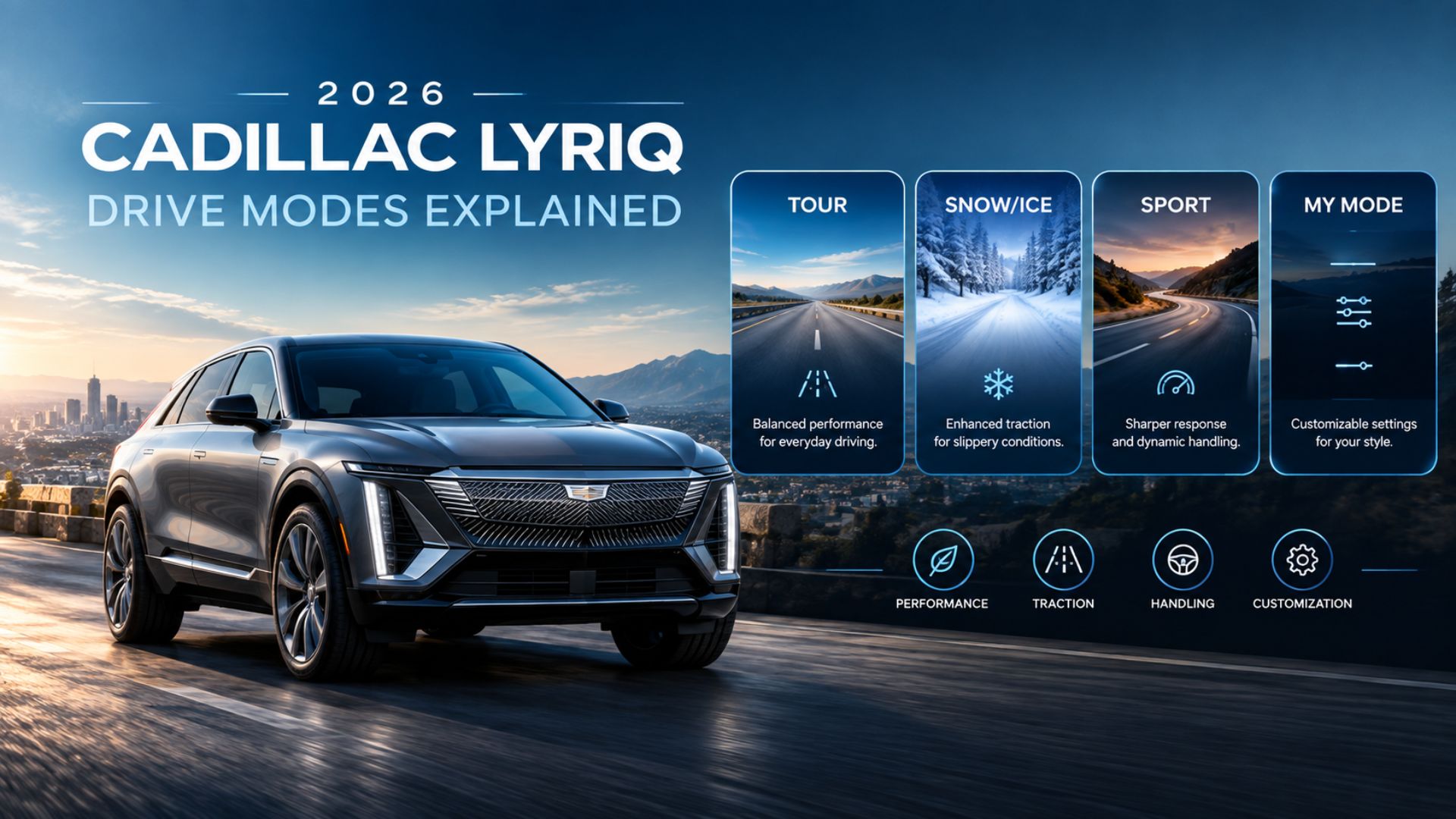
The 2026 Cadillac Lyriq drive modes help change how the vehicle responds to different roads and driving styles. The Cadillac Lyriq is a luxury electric crossover built around an electric powertrain. Its Driver Mode Control system lets you select settings that change parts of the driving experience. These settings can affect acceleration response, steering effort, braking response, traction behavior and other vehicle characteristics.
The regular 2026 Cadillac Lyriq offers Tour, Sport, Snow/Ice and My Mode depending on configuration. The high-performance LYRIQ-V adds V-Series performance features, including V-Mode and Velocity Max Mode. Cadillac says the LYRIQ-V can produce up to 615 horsepower and 650 lb.-ft. of torque in Velocity Max. It also has an EPA-estimated 285-mile range.
Key fact: A drive mode doesn’t change the physical size of the battery. It changes how the vehicle uses and delivers available energy.
Read More About: Droven io Best Tech Tools for Developers (2026): Complete Guide
What Are the Driving Modes in the 2026 Cadillac Lyriq?
The Cadillac drive modes are software-controlled settings that adjust the vehicle’s behavior. Cadillac calls the system Driver Mode Control. Available settings depend on the model and equipment. Tour is designed for normal everyday use. Sport provides a sharper response. Snow/Ice changes the pedal map to reduce wheel slip. My Mode allows more personal adjustment.
For most owners, these modes are about feel rather than creating a completely different vehicle. The 2026 Cadillac Lyriq remains an electric vehicle in every mode. Its battery capacity does not suddenly become larger or smaller. Instead, the software can change pedal mapping, power delivery, traction management and other settings. Cadillac also allows drive modes to be changed while the vehicle is moving.
A useful way to understand the system is to compare it with a smartphone performance setting. The hardware stays the same. The software changes how that hardware behaves. The same idea applies to the Lyriq.
| Drive mode | Main purpose | Typical driving situation |
| Tour Mode | Balanced comfort and everyday response | City and highway driving |
| Sport Mode | Sharper response and dynamic driving | Dry pavement |
| Snow/Ice Mode | Softer acceleration and improved traction | Snow-covered or icy roads |
| My Mode | Personalized vehicle settings | Driver-specific preferences |
| V-Mode | Performance-focused customization | LYRIQ-V |
| Velocity Max Mode | Maximum available propulsion performance | LYRIQ-V performance use |
Cadillac Lyriq Driving Modes Explained
Tour Mode
Tour Mode is the natural starting point for most everyday driving. Cadillac describes Tour as a setting for normal acceleration and comfortable ride tuning. It focuses on ride comfort, smoothness and balanced vehicle behavior. It can make sense for commuting, errands, city traffic and normal highway travel.
Tour is also associated with economical everyday operation. However, that doesn’t mean every trip in Tour will produce the same range. A driver who accelerates hard or travels at high speed can still use substantial energy. Road grade, weather, traffic and cabin temperature also matter.
Sport Mode
Sport Mode changes the vehicle toward a more responsive character. Cadillac describes Sport as providing tighter steering response and more responsive calibration. It is intended for a more engaging drive and is particularly suited to dry pavement.
In an EV, quick response can feel especially strong because the electric powertrain can deliver motor torque very quickly. Sport mode doesn’t magically create unlimited energy. Instead, it changes how the available propulsion system responds to driver input. Strong acceleration can therefore increase energy consumption during real-world driving.
Snow/Ice Mode
Snow/Ice Mode is designed for slippery surfaces. Cadillac says the setting changes the pedal map so acceleration and torque response are slower. The goal is to help prevent wheel slip.
That makes it useful when roads have snow, ice or other low-traction conditions. The mode doesn’t create grip where none exists. Instead, it helps make power delivery easier to manage. In an all-wheel drive Lyriq, the electric AWD system and traction controls can also play important roles in managing available grip.
My Mode
My Mode is the personalization setting. Cadillac describes it as a configurable mode that can adjust items such as steering, braking, acceleration feel, responsiveness and motor sound on equipped vehicles. These controls are accessed through the vehicle’s infotainment system.
This makes My Mode useful for drivers who want something between Tour and Sport. For example, a driver might prefer the comfort of a normal setting but want a more responsive acceleration feel. The exact choices depend on vehicle equipment.
V-Mode
V-Mode is associated with Cadillac’s V-Series performance vehicles rather than the standard Lyriq. The 2026 LYRIQ-V uses V-Mode to provide access to performance-focused settings. Cadillac says the system can save performance preferences and provide quick access through the V button or Drive Mode app.
On the LYRIQ-V, V-Mode is about more than a simple throttle change. It supports performance configuration and can provide access to Competitive Mode and other performance features. It is therefore better understood as a performance control system than a normal commuter setting.
Velocity Max Mode
Velocity Max Mode is a high-performance feature available on equipped Cadillac EVs. Cadillac says it unlocks additional horsepower and torque from the battery and electric drive units. It also draws more battery energy than regular driving.
The 2026 LYRIQ-V reaches a Cadillac-estimated 615 horsepower and 650 lb.-ft. of torque in Velocity Max. Cadillac quotes a 0–60 mph time of 3.3 seconds with Launch Control. The extra performance comes with an energy cost, so Velocity Max isn’t designed as an efficiency setting.
How Do Cadillac Lyriq Driving Modes Change the Driving Experience?
The Lyriq drive modes mainly change the relationship between driver input and vehicle response. The Driver Mode Control system can alter pedal mapping, steering calibration, braking feel and other settings. This creates different personalities without requiring a different battery pack.
The biggest difference can often be felt through acceleration. An EV already responds quickly because electric motors can produce strong torque at low speeds. A more performance-focused mode can make that response feel sharper. A winter-focused setting does the opposite. It makes power delivery easier to control on slippery roads.
Acceleration and Throttle Response
Acceleration response is one of the easiest changes to notice. Tour aims for smooth and predictable response. Sport emphasizes quicker acceleration and a more immediate feel. Snow/Ice reduces acceleration and torque response to help manage traction.
The result is a different relationship between the accelerator pedal and propulsion. The motor hardware doesn’t need to change. Software controls how aggressively the system responds to the driver’s input.
Steering and Handling
Drive modes can also influence steering effort and handling. Sport-oriented calibration can provide a tighter steering response. My Mode can provide personalization where supported.
These changes affect how the electric crossover feels through corners. Steering calibration doesn’t increase tire grip by itself. It changes the driver’s control response. Road conditions, tires, speed and vehicle load still determine the actual limits.
Regenerative Braking
Regenerative braking is another important part of EV driving. The electric motor can act as a generator during deceleration. This converts some vehicle motion back into electrical energy.
Cadillac also offers One-Pedal Driving and Regen On Demand on compatible EVs. One-Pedal Driving allows the accelerator pedal to help control deceleration. Regen On Demand uses a steering-wheel paddle.
Stability and Traction
Traction behavior becomes especially important on wet, snowy and icy roads. Snow/Ice Mode uses slower pedal response to help reduce wheel slip. On an AWD model, the all-wheel-drive system can also influence how available power reaches the road.
The goal isn’t maximum acceleration. The goal is controlled acceleration. That distinction matters when comparing dry-road performance with winter driving.
Do Cadillac Lyriq Driving Modes Affect Driving Range?
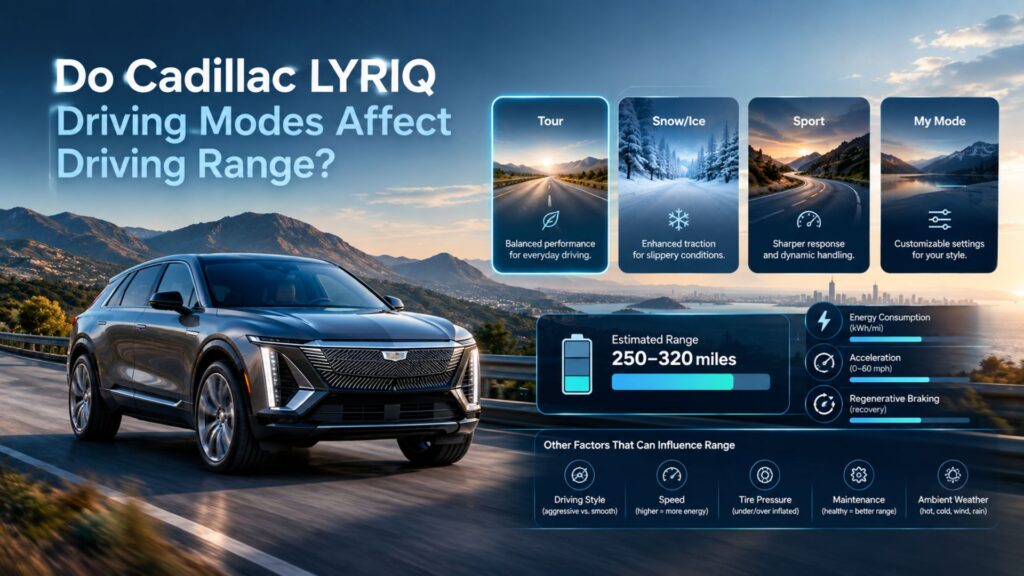
Yes, drive modes can affect energy use indirectly. They don’t change battery capacity. Instead, they can change how aggressively the vehicle delivers propulsion power and motor torque.
Tour is generally the efficiency-focused everyday setting. Sport can consume more energy when it encourages stronger acceleration. Velocity Max uses substantially more energy because Cadillac specifically says it draws more battery energy than regular driving.
The important point is that mode selection isn’t the only factor. A calm driver in Sport may use less energy than an aggressive driver in Tour. Speed, temperature, tires, terrain, wind, passengers and climate control can all affect actual range.
Does Sport Mode Use More Battery?
Sport Mode can use more battery when it leads to stronger acceleration and more dynamic driving. The mode itself doesn’t permanently reduce battery capacity. Instead, the driver may demand more energy from the propulsion system.
This distinction is important for EV owners. Think of the battery as a tank of stored energy. Sport doesn’t make the tank smaller. It can simply make it easier to consume the stored energy faster.
Velocity Max is different in degree. Cadillac directly states that the feature draws more energy than regular driving and can deplete the battery faster.
Is Tour Mode the Most Efficient Driving Mode?
Tour is the logical efficiency-focused choice for normal driving. Cadillac describes Tour/Normal as the most economical setting in its general Driver Mode Control guidance.
However, Tour Mode doesn’t guarantee the highest possible range on every trip. Driving behavior still matters. A gentle driver in Sport may consume less than an aggressive driver in Tour. This is why efficient driving depends on both the selected setting and the driver’s behavior.
Does Snow/Ice Mode Reduce Battery Efficiency?
Snow/Ice Mode isn’t designed primarily to maximize efficiency. Its purpose is traction control. Cadillac says it slows acceleration and torque response to help prevent wheel slip on slippery roads.
Winter conditions themselves can have a much larger effect on EV range than the mode selection. Cold weather affects battery performance and cabin heating demand. Snow can also increase rolling resistance. Therefore, a winter trip may use more energy even when Snow/Ice Mode is working correctly.
How My Mode Works on the Cadillac Lyriq
My Mode provides personalized driving behavior. On equipped Cadillac vehicles, the driver can adjust settings related to steering, braking, acceleration feel, responsiveness and motor sound. Cadillac places these controls within the vehicle’s infotainment system.
The benefit is simple. Not every driver wants an identical setup. One person may prefer light steering and smooth acceleration. Another may want stronger steering effort and quicker response. My Mode can help create a preferred combination where the vehicle supports those settings.
How Regenerative Braking Affects Lyriq Energy Use
Regenerative braking helps recover some energy that would otherwise be lost during deceleration. The electric motor can operate as a generator. Some of the vehicle’s kinetic energy is then returned to the battery.
Regeneration is useful in city traffic because the vehicle slows frequently. Yet it doesn’t create free energy. Some energy is always lost through electrical resistance, heat, tires, air resistance and other physical processes. Therefore, regeneration can improve efficiency but cannot fully replace energy used during acceleration.
One-Pedal Driving Explained
One-Pedal Driving lets the accelerator control both propulsion and much of the vehicle’s deceleration. When the driver lifts off the accelerator, the vehicle can slow through regenerative braking. Cadillac identifies this as an EV driving feature rather than simply another traditional drive mode.
The system can make stop-and-go driving feel smoother after the driver becomes familiar with it. It can also encourage predictable energy recovery. However, drivers should still use the brake pedal when stronger or emergency braking is needed.
Can Regenerative Braking Recover Energy?
Yes, regenerative braking can recover some energy. It cannot recover all the energy used to accelerate the vehicle. The process has unavoidable losses.
The biggest benefit usually comes from avoiding unnecessary energy loss during repeated slowing. Smooth acceleration followed by controlled deceleration can support efficient EV driving.
What Factors Affect Cadillac Lyriq Range?
Drive modes are only one part of the range equation. Real-world electric vehicle range changes with speed, weather, terrain, tire pressure, load and climate settings.
This is why two Lyriq drivers can achieve different results on the same battery. The EPA estimate provides a standardized reference. It isn’t a promise of identical real-world range.
| Range factor | Typical effect on driving |
| Speed | Higher speeds generally require more energy |
| Temperature | Cold conditions can reduce efficiency |
| Tire pressure | Incorrect pressure can increase resistance |
| Cargo and passengers | More weight requires more energy |
| Wind | Strong headwinds increase energy demand |
| Terrain | Hills require additional propulsion energy |
| Climate control | Heating and cooling use electrical energy |
Driving Speed
Highway speed can have a strong effect on EV energy use. Air resistance rises quickly as speed increases. This means a faster highway trip can consume considerably more energy than slower city driving.
For range-focused travel, steady and moderate speeds can help. Sudden acceleration also increases energy demand.
Outside Temperature
Temperature affects both the battery and the cabin. Very cold conditions can reduce EV efficiency. Heating the cabin also requires energy.
Hot weather can increase air-conditioning demand. Battery thermal management can also consume energy when the system needs to keep components within suitable operating temperatures.
Tire Pressure
Correct tire pressure helps maintain efficient rolling resistance. Underinflated tires can increase resistance and reduce efficiency.
For an EV like the Lyriq, following the manufacturer’s recommended tire pressure is a simple way to support consistent range and handling.
Cargo and Passenger Weight
Extra weight requires additional energy to accelerate. The difference may be small for a single trip, but unnecessary heavy cargo can reduce efficiency over time.
This is particularly noticeable during repeated stop-and-go driving. Removing items that aren’t needed can help reduce vehicle load.
Wind and Terrain
A strong headwind increases aerodynamic resistance. Hills also require additional energy because the vehicle must gain elevation.
Regeneration can recover some energy while descending. However, it won’t recover all the energy used to climb.
Climate Control
Heating and cooling can affect EV range. Cabin heating can be especially noticeable in cold weather because it adds electrical demand.
Using climate settings wisely can reduce unnecessary consumption. Preconditioning while plugged in can also help prepare the cabin and battery before departure when supported by the vehicle.
Battery Preconditioning and Thermal Management
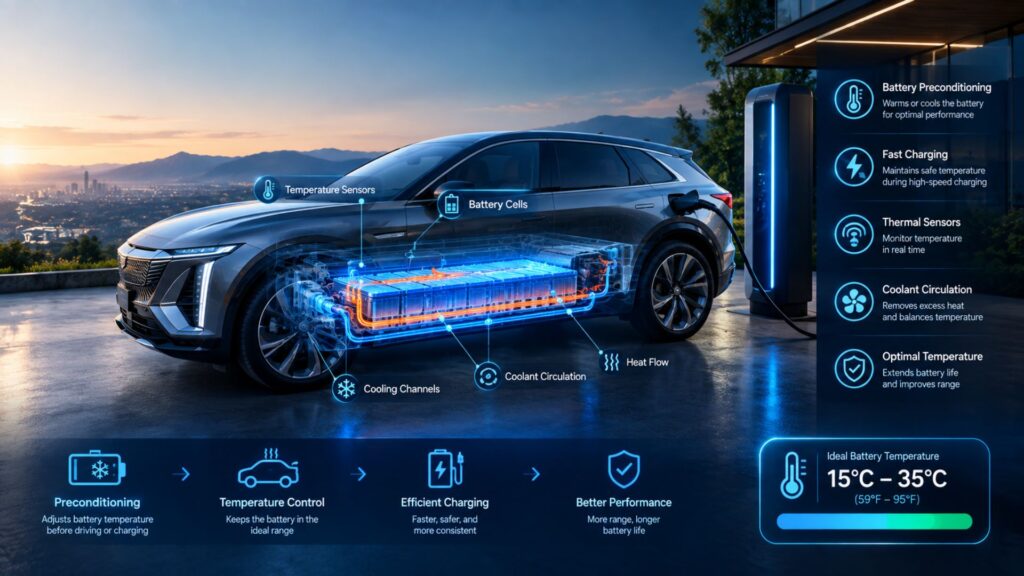
Battery temperature matters because an EV battery performs differently across temperature ranges. The propulsion system uses thermal management to help control battery and drive-unit temperatures.
Preconditioning can prepare the vehicle before a trip or charging session. When the vehicle is connected to external power, some energy can come from the grid rather than the battery. The exact behavior depends on vehicle settings and conditions.
Why Battery Temperature Matters
Battery temperature can affect charging performance and energy efficiency. Cold conditions can be particularly challenging because the battery needs thermal management while the cabin may also require heating.
This is one reason winter EV driving can produce lower range. The effect is not simply caused by Snow/Ice Mode.
Benefits of Preconditioning
Preconditioning can improve comfort before departure. It can also help place the battery and cabin closer to suitable operating temperatures.
For long trips, this can be useful. It allows the driver to begin with a prepared vehicle instead of using additional battery energy immediately after leaving.
Which Cadillac Lyriq Drive Mode Should You Use?
The right Cadillac Lyriq drive mode depends on the road and the desired response. There isn’t one setting that fits every situation.
The tour works well as the normal starting point. Snow/Ice makes sense when traction is limited. Sport suits dry roads and drivers who want a sharper response. My Mode works for personalized preferences. LYRIQ-V owners have additional performance controls.
| Driving situation | Suitable setting | Main reason |
| Daily commuting | Tour Mode | Smooth everyday response |
| Highway driving | Tour Mode | Balanced operation |
| Mountain roads | Tour or My Mode | Controlled response and personalization |
| Snow and ice | Snow/Ice Mode | Reduced wheel-slip risk |
| Performance driving | Sport Mode | Sharper response |
| LYRIQ-V performance | V-Mode / Velocity Max | Maximum performance settings |
| Stop-and-go traffic | Tour + suitable regen setting | Smooth control |
Daily Commuting
For city driving, Tour is a sensible default. It provides a balanced combination of comfort and predictable acceleration.
Traffic often requires repeated acceleration and braking. Smooth pedal control can matter more than selecting an aggressive mode.
Highway Driving
For highway driving, Tour provides a comfortable and balanced setup. Maintaining a steady speed can have a larger effect on energy use than simply switching modes.
Sport can still be used on dry roads. The driver should understand that stronger acceleration can increase energy consumption.
Mountain Roads
Mountain roads require careful control. A personalized My Mode setup may suit drivers who prefer a particular steering or response level.
Elevation changes can also influence range. Climbing consumes energy. Descending can return some energy through regeneration.
Snow and Ice
Snow/Ice Mode is designed for winter driving. Its slower acceleration and torque response can help optimize traction on slippery roads.
Drivers should still reduce speed and leave extra stopping distance. No drive mode can eliminate the limits created by ice or poor tires.
Performance Driving
Sport is suited to performance-oriented driving on appropriate dry roads. The LYRIQ-V takes this idea much further through V-Series hardware and software.
The LYRIQ-V uses dual-motor AWD and offers continuous damping control and performance brakes. Cadillac says Velocity Max enables its maximum quoted propulsion output.
Stop-and-Go Traffic
Stop-and-go traffic can benefit from smooth accelerator control and regenerative braking. One-Pedal Driving can also simplify repeated slowing for drivers who like that style.
The goal should be predictable inputs. Hard acceleration followed by hard braking wastes energy compared with smooth traffic flow.
Read More About: Truzio Explained: What Is Truzio and Why Is It Trending Online?
Do Driving Modes Affect Long-Term Battery Health?
Normal use of the available drive modes does not mean that the battery will suddenly become damaged. Drive modes are designed vehicle functions.
The bigger issue is energy consumption. Repeated high-performance operation can drain the battery faster during a trip. Cadillac specifically warns that repeated Velocity Max use can deplete battery power faster.
Battery aging depends on many factors. Temperature, charging patterns, battery age and usage conditions all matter. A driver shouldn’t assume that simply selecting Sport permanently harms the battery.
Common Myths About Cadillac Lyriq Drive Modes
Sport Mode Damages the Battery
Sport Mode does not mean the battery is being damaged every time it is selected. The mode changes vehicle response. More aggressive acceleration can increase energy consumption, but normal use of the mode is part of the vehicle’s intended operation.
Tour Mode Always Gives the Highest Range
Tour Mode is the efficiency-oriented everyday setting. However, it cannot overcome extreme speed, cold temperatures, strong wind or aggressive driving. Actual range depends on the complete driving situation.
One-Pedal Driving Doubles Range
One-Pedal Driving can support smooth regenerative deceleration. It doesn’t double the battery range. Regeneration recovers only part of the energy that was previously used.
Driving Modes Change Battery Capacity
This is incorrect. Drive modes don’t turn a smaller battery into a larger one. They change software behavior, power delivery and other vehicle characteristics.
Cadillac Lyriq Drive Mode Comparison
The simplest comparison is to think about the purpose of each setting. Tour is the everyday baseline. Sport increases responsiveness. Snow/Ice prioritizes controlled acceleration. My Mode provides personalization. V-Mode and Velocity Max are performance-focused features for the LYRIQ-V.
| Feature | Tour | Sport | Snow/Ice | My Mode | V-Mode | Velocity Max |
| Everyday use | Yes | Possible | Weather dependent | Yes | Performance use | No |
| Comfort focus | High | Lower | Moderate | Adjustable | Performance focused | Low |
| Quick response | Balanced | High | Reduced | Adjustable | High | Maximum |
| Traction focus | Normal | Dry-road focus | High | Adjustable | Performance | Performance |
| Personalization | Limited | Limited | Limited | High | High | Performance-focused |
| Extra energy demand | Usually balanced | Can increase | Condition dependent | Depends on setup | Depends on setup | High |
| Standard 2026 LYRIQ | Yes | Yes | Yes | Yes | No | No |
| LYRIQ-V | — | — | — | Yes | Yes | Yes |
The standard 2026 LYRIQ and the 2026 LYRIQ-V should not be treated as having identical mode lineups. Cadillac lists Tour, Snow/Ice, Sport and My Mode for the regular LYRIQ, while the LYRIQ-V adds its V-Series performance system.
Tips to Maximize Cadillac Lyriq Driving Range
Efficient EV driving starts with smooth inputs. Moderate highway speeds, correct tire pressure and sensible climate control can all help. A tour is a useful starting point for normal travel.
Avoid unnecessary use of maximum-performance features when range matters. Cadillac specifically warns that Velocity Max consumes battery energy faster than regular driving.
A useful range strategy also includes understanding technical factors that can affect vehicle software. Although terms such as career subdomain, careers page, careers website, recruitment portal, job listings, recruitment website, company website, DNS records, DNS settings, DNS propagation, A record, CNAME record, nameservers, SSL certificate, HTTPS, hosting provider, web hosting, website migration, website redesign, reverse proxy, CDN cache, Applicant Tracking System, ATS integration, HTTP status codes, redirects, career portal, job seekers, recruiters, search visibility, organic traffic, internal links, job pages and website accessibility belong to web technology rather than automotive technology, they illustrate an important principle: the system works correctly only when its underlying components are configured correctly.
The same principle applies to an EV. A drive mode can change software behavior, but it doesn’t replace the physical limits of the battery, tires, motors and road surface.
Technical SEO Terms That Should Not Be Confused With Lyriq Drive Modes
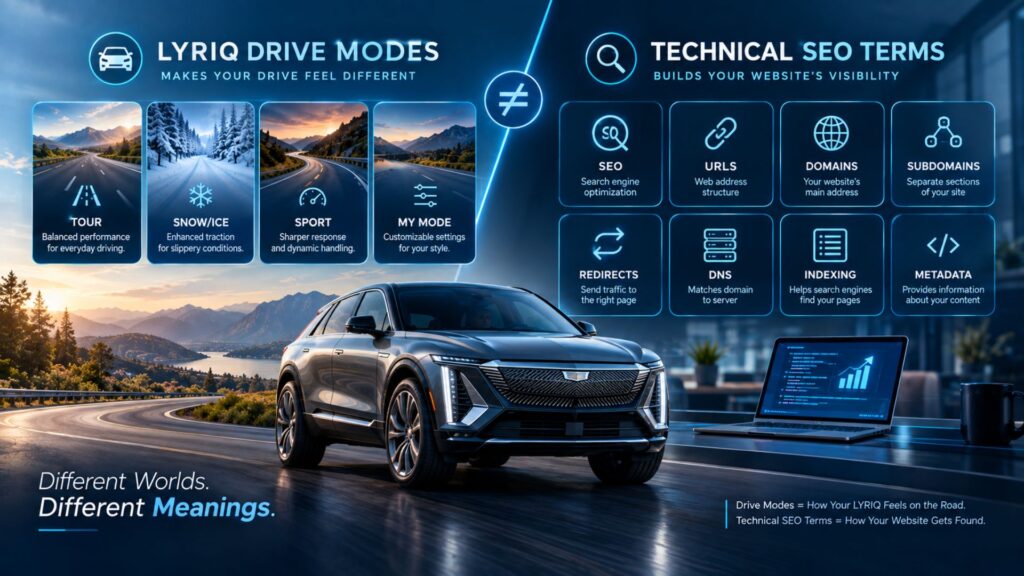
Some search results may mix automotive searches with unrelated technical terms. For example, phrases such as Keine Karriere-Subdomain Gefunden, no career subdomain found, missing career subdomain, inaccessible careers page, dedicated careers portal, recruitment system, Applicant Tracking Systems, DNS configuration, incorrect subdomain configuration, missing DNS records, expired hosting, SSL certificate problems, CDN or cache errors, ATS integration failures, website migration problems, server configuration, web server routes, firewall settings, reverse proxy configuration, host headers, load balancer settings, API credentials, permanent redirects, HTTP 404 error, HTTP 403 error, HTTP 500 error, HTTP 502 error, HTTP 503 error, DNS lookup, SSL status, URL verification, career portal access, job application access, search engine visibility, crawl efficiency, broken internal links and website downtime describe websites and recruitment systems. They aren’t features of the Cadillac Lyriq.
For context, a company’s domain architecture, subdomain management and recruitment infrastructure can determine whether a careers portal works. Technical SEO, server-side configuration, the domain name system, DNS resolution, DNS propagation, the hostname, server routing, virtual hosts, a reverse proxy, load balancing, a content delivery network, caching, SSL/TLS security and certificate validation can all affect whether a website loads correctly.
These terms can also describe technical problems after website deployment or website migration. Proper URL routing, redirect management, third-party recruitment platforms, applicant tracking technology, API integration, job vacancy pages, recruitment workflows, candidate experience and a hiring portal are important for HR technology. Technical teams may use technical troubleshooting, server errors, search engine crawling, indexing, organic search visibility, website maintenance, post-deployment testing, DNS audits and automated SSL renewal to keep such systems working.
They have no direct connection with automotive technology, electric vehicle technology, luxury electric crossover, vehicle dynamics, drive-mode control, driving modes, driving conditions, power delivery, throttle response, steering calibration, brake feel, suspension behavior, all-wheel-drive system, traction management, wheel slip reduction, power distribution, handling characteristics, ride comfort, acceleration performance, motor torque, propulsion system, electric powertrain, motor sound, infotainment customization, personalized vehicle settings, performance configuration, V-Series performance, propulsion cooling, pedal mapping, dry-road handling, winter driving, snow and ice traction, everyday driving, highway driving, city driving, performance-oriented driving or maximum responsiveness.
This distinction matters for search accuracy. A search for 2026 Cadillac Lyriq drive modes should lead to information about the vehicle’s Driver Mode Control system, not a recruitment portal or technical website diagnosis.
Frequently Asked Questions
Do Cadillac Lyriq driving modes change battery capacity?
No. 2026 Cadillac Lyriq drive modes change vehicle behavior rather than the physical battery capacity. They can affect energy consumption through power delivery and driving response.
Which Cadillac Lyriq mode offers the best range?
Tour is the normal efficiency-oriented setting. Cadillac describes Tour/Normal as the most economical setting in its general Driver Mode Control guidance. Actual range still depends on speed, weather, terrain, tires and driving style.
Does Sport Mode use more battery?
It can. Sport encourages a more responsive driving character. If that leads to stronger acceleration, energy consumption can increase.
Is My Mode more efficient than Tour Mode?
Not automatically. My Mode depends on the settings selected by the driver. A mild configuration may feel similar to Tour. A more aggressive configuration can increase energy demand.
Does One-Pedal Driving improve range?
It can support efficient driving by using regenerative braking during deceleration. However, it cannot recover all energy used during acceleration. Cadillac describes One-Pedal Driving as an EV feature that helps control deceleration with the accelerator pedal.
Why does cold weather reduce EV range?
Cold temperatures can affect battery efficiency. Cabin heating also requires electrical energy. Winter road conditions can add rolling resistance. These effects can reduce real-world range.
Can regenerative braking fully recharge the battery while driving?
No. Regeneration can recover some energy during deceleration. It cannot return all the energy used to accelerate because physical and electrical losses remain.
Which mode is best for highway driving?
Tour is a practical choice for normal highway travel. The larger range factors are usually speed, wind, temperature, traffic and acceleration behavior.
Can you switch driving modes during a trip?
Yes. Cadillac states that drive modes can be changed while the vehicle is moving. The exact selection method depends on the vehicle’s equipment.
Does driving mode affect charging speed?
Drive mode and charging speed are different functions. Charging speed depends on the charging system, battery conditions, temperature, charger capability and vehicle configuration. Velocity Max is about propulsion performance rather than increasing charging speed.
Conclusion
The 2026 Cadillac Lyriq drive modes give owners several ways to adjust the vehicle’s response. Tour is the balanced everyday setting. Sport adds a more responsive character. Snow/Ice changes pedal response to help reduce wheel slip. My Mode provides personalization.
The LYRIQ-V takes the idea further. V-Mode provides performance-focused customization, while Velocity Max Mode unlocks additional power and torque. Cadillac says Velocity Max uses more battery energy than regular driving. The 2026 LYRIQ-V reaches a Cadillac-estimated 615 horsepower and 650 lb.-ft. of torque in this setting.
The most important lesson is simple. A drive mode doesn’t change the physical size of the battery. It changes how the vehicle responds. For normal driving, Tour provides a balanced starting point. For dry-road performance, Sport offers a sharper response. For slippery roads, Snow/Ice helps manage acceleration. For personal preferences, My Mode adds control. LYRIQ-V drivers have additional performance settings.
Range still depends on the complete driving situation. Speed, temperature, tire pressure, terrain, wind, vehicle load and climate control can matter as much as the selected mode. Understanding these factors helps you use the Cadillac Lyriq more confidently and efficiently.