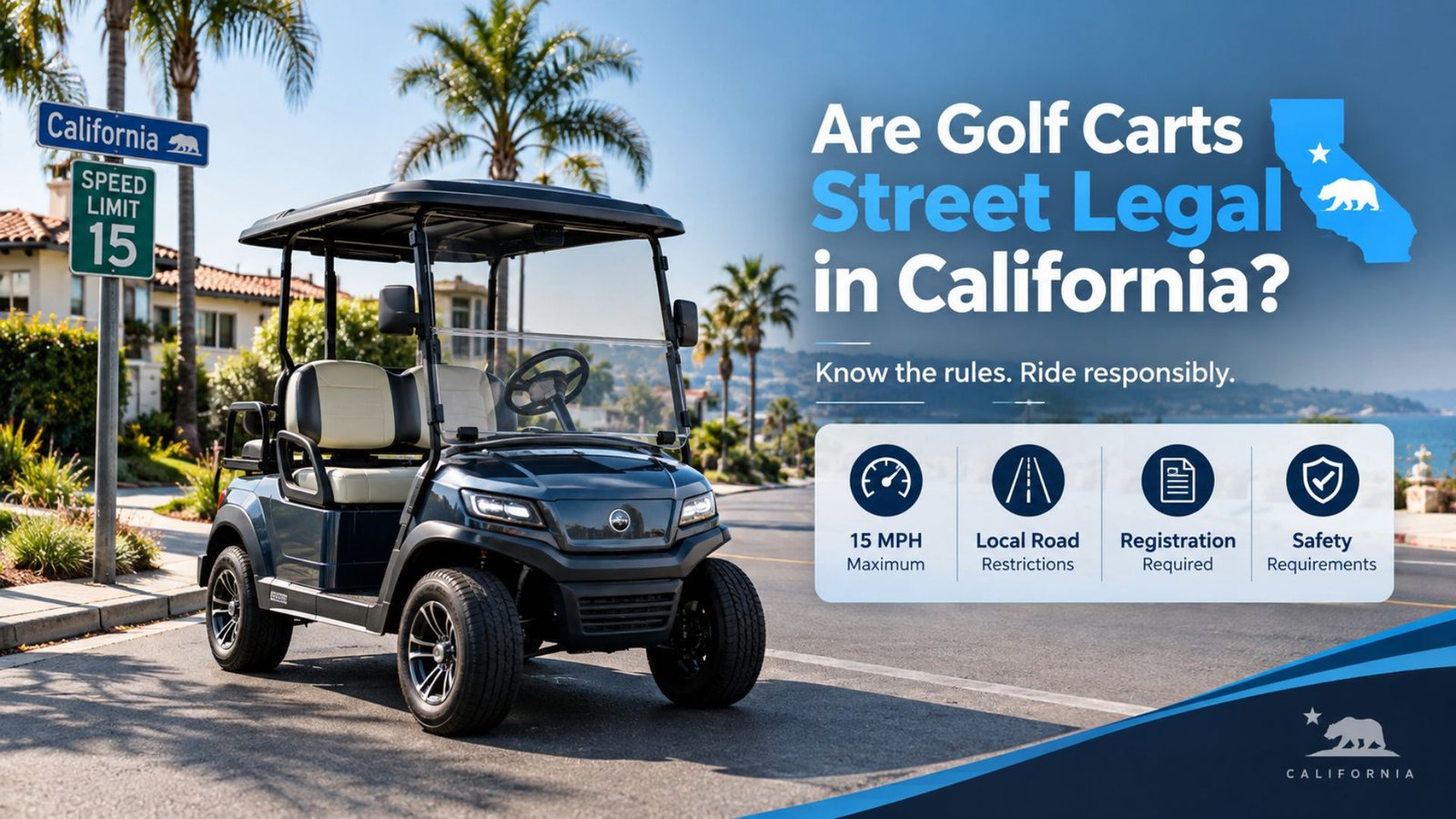
Are Golf Carts Street Legal in California? Laws, LSV Rules & Requirements
Picture a sunny morning in Palm Desert. You want a coffee two blocks away. Firing up the car feels silly. So you look at your cart and wonder, are golf carts street legal in California?
The short answer is sometimes. A plain cart has narrow rights. A registered Low Speed Vehicle (LSV) has far more. This guide explains California golf cart laws in easy English. You’ll learn what makes a golf cart street legal, how LSV registration works, and where you can ride.
Read More About: Denago Golf Carts Review: Models, Prices, Features, Reliability & Buying Guide
California Golf Cart Laws: What You Need to Know
California golf cart laws sort every cart into one of two groups. One group is the standard golf cart. The other is the street legal LSV. Your group decides where you can drive, what gear you need, and whether you must register.
Three bodies shape the rules. The California DMV handles titles and plates. The California Vehicle Code sets the legal definitions. Cities and counties can add limits of their own. That’s why golf carts in California follow slightly different golf cart laws by city. Always check the DMV’s official LSV and golf cart page first.
What Qualifies as a Golf Cart Under California Law?
What qualifies as a golf cart in California comes down to size, weight, and speed. Under California Vehicle Code Section 345, a golf cart has at least three wheels, weighs under 1,300 pounds empty, tops out at 15 mph, and carries golf gear plus no more than two people. That makes it a true 15 mph golf cart. Think of it as a small, slow tool for the course and its neighbors. Add a bigger motor or extra seats, and it no longer fits the definition.
Golf Cart vs. LSV: What’s the Difference?
What is the difference between a golf cart and an LSV? Speed, paperwork, and safety gear. An LSV has four wheels and reaches more than 20 mph but no more than 25 mph. It also carries a 17-digit VIN, weighs under 3,000 pounds by gross rating, and meets federal safety standards. The table below shows the golf cart vs LSV split at a glance.
| Feature | Standard golf cart | Registered LSV |
| Top speed | 15 mph | 25 mph |
| Weight rule | Under 1,300 lbs empty | Under 3,000 lbs GVWR |
| DMV registration | Generally not required | Required |
| Driver’s license | Yes, on public roads | Always |
| Insurance | Recommended | Required (30/60/15) |
| Seat belts | Not required | Required |
| Road access | Limited and local | Roads up to 35 mph |
Many people ask about NEV vs LSV California. Good news: they mean the same thing in state law. NEV is the sales term. LSV is the legal one.
Are Golf Carts Street Legal in California?
Are golf carts legal on California roads? A standard cart can use public roads only in narrow cases. It needs a road the city has designated, or a quiet street near a course. A registered LSV can use most 35 mph roads. This rule covers golf cart laws for public roads and for residential streets. The DMV puts it neatly: an LSV “may look like a golf-cart to the casual observer,” yet it’s really a motor vehicle.
California Street-Legal Golf Cart Requirements
What makes a golf cart street legal in California? Four things do the job. The cart needs certified equipment and a factory VIN. It needs DMV registration and a plate. The driver needs a valid license. And you need insurance. Miss one, and you’re not covered.
How to make a golf cart street legal in California is a common search. Here’s the honest answer. The easiest path is buying a factory-built LSV from a licensed dealer. Those carts arrive with FMVSS 500 gear installed. They also come with the paperwork ready for the DMV.
Required Equipment and Safety Features
What equipment does a street legal golf cart need? The federal standard, FMVSS 500, sets the list. It calls for headlamps, turn signals front and rear, taillamps, stop lamps, reflex reflectors, mirrors, a parking brake, a certified windshield, a VIN, and seat belts at each seat. Read the full rule at 49 CFR 571.500. The table turns that into a street legal golf cart checklist.
| Item | Plain-English meaning |
| Golf cart headlights and taillights | Working lights day and night |
| Turn signals | Front and rear lamps |
| Brake lights | Light up when you brake |
| Reflectors | Red on each rear side and the back |
| Rear-view mirrors | Driver side, plus passenger side or interior |
| Windshield | Meets federal glazing rules |
| Seat belts | One set per seat |
| Parking brake | Holds the cart on a slope |
| 17-digit VIN | Assigned by the maker |
So, does a golf cart need headlights in California? An LSV does. Do golf carts need seat belts in California? LSVs do. Do golf carts need mirrors? Yes. Does a golf cart need a windshield? An LSV does. Does a golf cart need a VIN? Yes, always. The federal list doesn’t name windshield wipers. Still, some fleets add them, so ask your dealer.
The 35 MPH LSV Rule Explained
Can golf carts drive on 35 mph roads? Registered LSVs can. Can an LSV drive on a 40 mph road? No. An LSV can’t operate on a roadway posted above 35 mph, though it may cross faster intersections when the crossing starts and ends on a 35 mph or slower road. That’s the heart of the LSV speed limit rule. Cities can also ban LSVs on certain streets under California Vehicle Code 21266. So can LSVs drive on highways in California? No.
License Plate and Registration Requirements
Does a golf cart need a license plate in California? A registered LSV does. The plate goes on the rear. A cart that stays on private property or the course usually doesn’t need one. Do golf carts need to be registered in California? That depends on use. Public roads mean LSV registration. Private land means no plate.
California DMV Registration for Golf Carts and LSVs
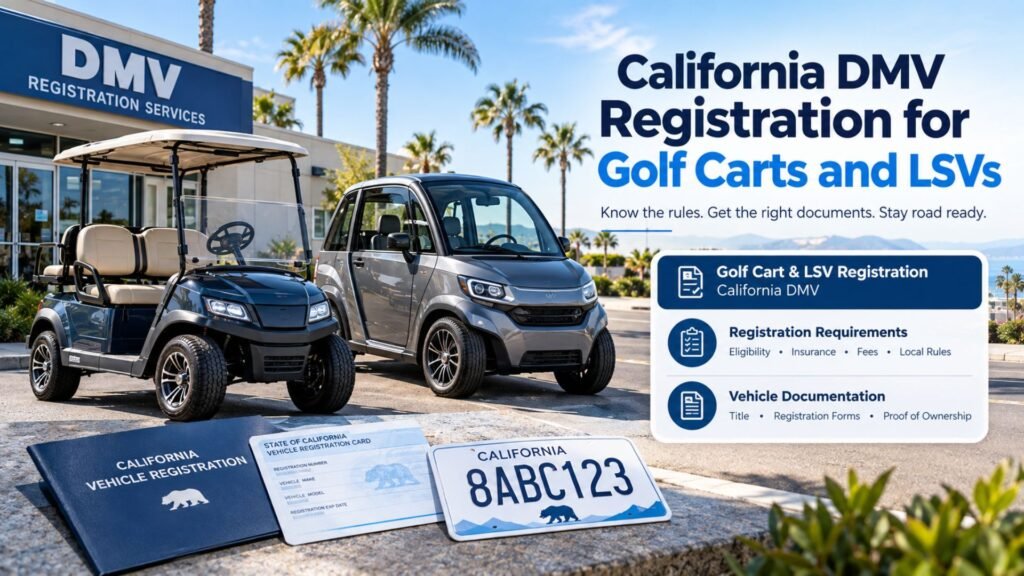
Do you need to register a golf cart in California? Plan on it if you’ll leave private ground. DMV golf cart registration works like registering a car. A dealer can handle most steps for you. Private buyers and out-of-state buyers visit the DMV themselves.
The DMV cares about how you use the cart. It doesn’t care how the cart looks. That’s why California DMV requirements feel strict for LSVs and light for standard carts. Still, can you drive a golf cart without registration? Only in the narrow cases the law allows. Everywhere else, an unregistered cart invites trouble.
How to Register a Street-Legal Golf Cart
How to register an LSV in California takes five steps. The same path answers how to register a golf cart with the California DMV. The table lays it out.
| Step | What you do |
| Gather papers | Collect the MCO or title, REG 343, and insurance proof |
| Check gear | Confirm every required item works |
| Submit | Dealer files it, or you visit the DMV |
| Pay | Registration fees are due each year |
| Get plates | Mount the plate on the rear |
Documents and Requirements You May Need
California LSV registration requirements center on three items. You need the Manufacturer’s Certificate of Origin or a title. You need a filled-out REG 343 form. And you need proof of insurance. The DMV may also ask for a vehicle check. A missing golf cart VIN stops everything. Adding one later isn’t an option.
Insurance Requirements for Street-Legal Golf Carts
Does an LSV need insurance in California? Yes. Your cart needs liability insurance at state minimums. Since January 1, 2025, California’s minimums under SB 1107 are $30,000 per person, $60,000 per accident, and $15,000 for property damage. That’s what people mean by 30/60/15 insurance. The minimums are set to rise again in ten years, to 50/100/25. Details are in this Carrier Management report.
How much does golf cart insurance cost in California? Quotes vary. Your driving record, cart value, and coverage choices all matter. Ask carriers that also cover motorcycles. They often write LSV insurance. California LSV insurance requirements stay the same either way. Standard carts on private land don’t need a state policy. Still, a standalone golf cart insurance plan is smart. Many homeowner’s policies stop at the property line.
Age Requirements: How Old Do You Have to Be to Drive a Golf Cart in California?
How old do you have to be to drive a golf cart in California? On public roads, most drivers need to be 16 with a license. A teen with a permit may drive with a licensed adult. Legal commentary notes that a learner’s permit holder can’t drive an LSV alone. See the Maison Law summary. Confirm the exact wording with the DMV.
Do you need a license to drive a golf cart in California? On public roads, yes. That’s the California golf cart driver’s license requirement. The California golf cart age requirement follows the same logic. So can a learner’s permit holder drive a golf cart in California? Yes, with adult supervision. Cities warn that an unlicensed teen can be cited, and a parent can face a misdemeanor for allowing it. Read the Norco city notice.
Where Can You Drive a Golf Cart in California?
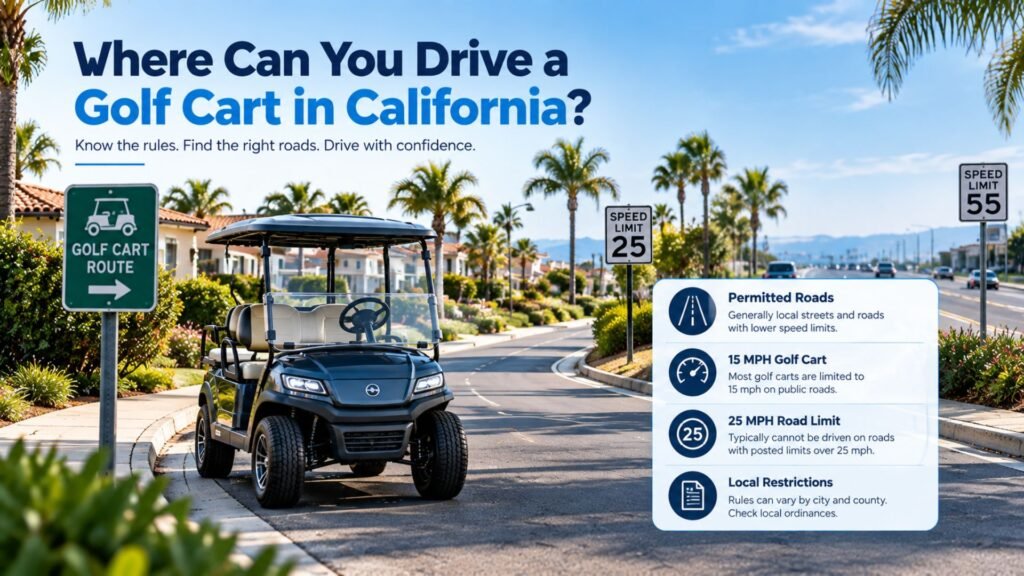
Where can you drive a golf cart in California? Where your cart type and your city allow. Rules differ between a beach town and a master-planned community. Visitors should check local rules before hauling a cart in. California golf cart road rules can change at a city line.
Every buyer should learn three facts. First, LSV drivers stay on roads up to 35 mph. Second, plain carts get less freedom. Third, cities can restrict or ban either type. Check the local golf cart ordinances before you buy.
Where Golf Carts Are Allowed
Where are golf carts allowed in California? Private property and golf course golf carts areas come first. Roads next to a course also count. A city can designate a road for combined use, and outside a development that road can run no more than one mile from the course. Read California Vehicle Code 21115. These are designated golf cart roads. What roads can LSVs drive on? Most streets posted at 35 mph or less.
Golf Cart-Friendly Communities in California
California golf cart communities keep growing. Palm Desert, Catalina Island, and the Coachella Valley are well known for cart life. Many HOA neighborhoods near Rocklin, Benicia, Napa, Chico, and Fresno allow carts on community roads. These golf cart friendly communities often mark neighborhood golf carts routes. Ask your city’s public works team for a map. That’s the golf cart lifestyle in action.
Where Golf Carts Are Not Allowed
Can golf carts drive on sidewalks? Generally no. LSVs count as motor vehicles, so sidewalks and bike paths aren’t for them. Can golf carts be driven in an HOA community? Often yes, but the HOA decides on private roads. Does an HOA need to approve a golf cart? Check your governing documents. Are golf carts allowed on private roads? Usually, subject to the owner’s rules. Freeways and roads above 35 mph stay off limits. These are the core golf cart road restrictions.
Buying a Street-Legal Golf Cart vs. Converting One
Can you convert a regular golf cart into an LSV? Not by adding parts. Can you make a golf cart street legal by adding lights? No. An LSV needs a manufacturer VIN and LSV certification for FMVSS 500. A golf cart conversion can’t create either. The DMV also warns that a modified LSV that goes faster than 25 mph loses its relaxed status.
Buying a street legal golf cart in California is simpler. A factory-built street legal LSV arrives ready. The dealer files the DMV forms. You skip the guesswork. Ask about best street legal golf carts in California at a licensed showroom. Many stock electric golf carts and a street legal electric golf cart in several trims. Nick’s Golf Cars serves Fresno, Rocklin, Chico, Benicia, and Napa. The table compares your options.
| Path | Difficulty | Main risk |
| Buy new LSV | Easy | Higher upfront cost |
| Buy used LSV | Moderate | Check VIN and papers |
| Convert a cart | Hard | May never qualify |
California Golf Cart Safety and Compliance
What are the California golf cart safety requirements? Working gear, valid papers, and careful driving. Test lights, brakes, and mirrors before each ride. Renew your registration every year. Keep proof of insurance handy. These habits make golf cart compliance painless.
Good golf cart maintenance protects you. Charge batteries on schedule. Check tire pressure and brake feel. Safe golf cart operation means buckling up, slowing at corners, and lighting up at dusk. Follow the LSV safety standards and motor vehicle safety standards that apply. Think of your cart like a small car. It deserves the same respect.
What Happens If You Don’t Follow California Golf Cart Laws?
What happens if you drive an unregistered golf cart? You can get cited. Police may impound the cart. Cities list violations such as no license, no registration, no insurance, and no seat belt, with a possible 30-day impound. The stakes rise after a crash.
Picture a fender-bender in a 35 mph zone. The other driver’s repair bill arrives. Your homeowner’s policy may not pay. You could owe the cost yourself. That’s why golf cart laws for public roads exist. Follow them, and you protect your wallet and your neighbors.
Read More About: Google Pixel 10 Pro One Year Review: Features, Camera, Problems & Long-Term Experience
Frequently Asked Questions
Are golf carts street legal in California?
Are golf carts street legal in California? Yes, in limited cases. A registered LSV can use roads posted 35 mph or less. A standard cart stays on private land and designated routes.
Do you need a license to drive a golf cart in California?
Do you need a license to drive a golf cart in California? Yes, on public roads. An LSV driver always needs a valid California driver’s license.
How old do you have to be to drive a golf cart in California?
How old do you have to be to drive a golf cart in California? Sixteen with a license. Some sources allow a permit holder with a licensed adult. Verify with the DMV.
Does a golf cart need a license plate in California?
Does a golf cart need a license plate in California? A registered LSV does. A cart kept on private property generally doesn’t.
Do golf carts need insurance in California?
Do golf carts need insurance in California? LSVs do. Carry at least 30/60/15 liability.
What makes a golf cart street legal in California?
What makes a golf cart street legal in California? A factory VIN, FMVSS 500 gear, DMV registration, a plate, a licensed driver, and insurance.
Can you drive a golf cart on public roads in California?
Can you drive a golf cart on public roads in California? Only as a registered LSV on 35 mph roads. Or on a road your city designates.
What is the difference between a golf cart and an LSV?
What is the difference between a golf cart and an LSV? An LSV is faster, certified, and registered. A golf cart tops out at 15 mph. How fast can a golf cart go in California? 15 mph. How fast can an LSV go in California? 25 mph.
Conclusion
So, are golf carts street legal in California? Yes, when you choose a compliant LSV. Register it. Ensure it. Keep it on 35 mph roads. Those three moves cover most of the law.
Check your city rules before you ride. Then talk to a licensed dealer. Nick’s Golf Cars can walk you through models and paperwork. Call 1-800-552-0606 or visit a showroom. You’ll be cruising legally in no time.

Ryan Cooper is a dedicated writer with a passion for creating informative and engaging content. He enjoys sharing valuable insights and helping readers stay updated with the latest trends and practical knowledge.