
Truzio Explained: What Is Truzio and Why Is It Trending Online?
Search “Truzio” today, and you’ll get a mixed bag of results. That’s confusing, and it’s worth untangling before you make any business decisions based on what you find. This guide walks you through what Truzio Explained actually refers to, how its ERP software works, and why the name keeps popping up across different corners of the internet.
What Is Truzio?
Truzio isn’t one single company. It’s a name shared by a few unrelated businesses, and that overlap is exactly why searches get messy. The most established use of the name belongs to Truzio Technologies, a Hyderabad-based IT services and enterprise resource planning (ERP) firm founded in 2012 (Inc42).
A second, entirely separate business also uses the name: Truzio.co, a data validation and enrichment platform. It’s run by a company called Lentrax Ltd out of London, and it has nothing to do with ERP software or business transformation consulting (Media Clicks). You’ll want to keep these two straight, because mixing them up leads to real confusion about what you’d actually be signing up for.
Quick Answer: What Is Truzio?
In short: Truzio Technologies builds and supports open-source ERP systems for businesses that want an alternative to expensive licensed software. Truzio.co, on the other hand, checks and cleans your data things like phone numbers, emails, and IBANs. Same name, two very different jobs.
Understanding the Truzio Name and Its Different Uses
Names collide online more often than you’d think, especially short, punchy ones like Truzio. Before you dig into features or pricing, figure out which Truzio you’re actually looking at. That one step saves you a lot of wasted research time later on.
Truzio Technologies and Digital Business Solutions
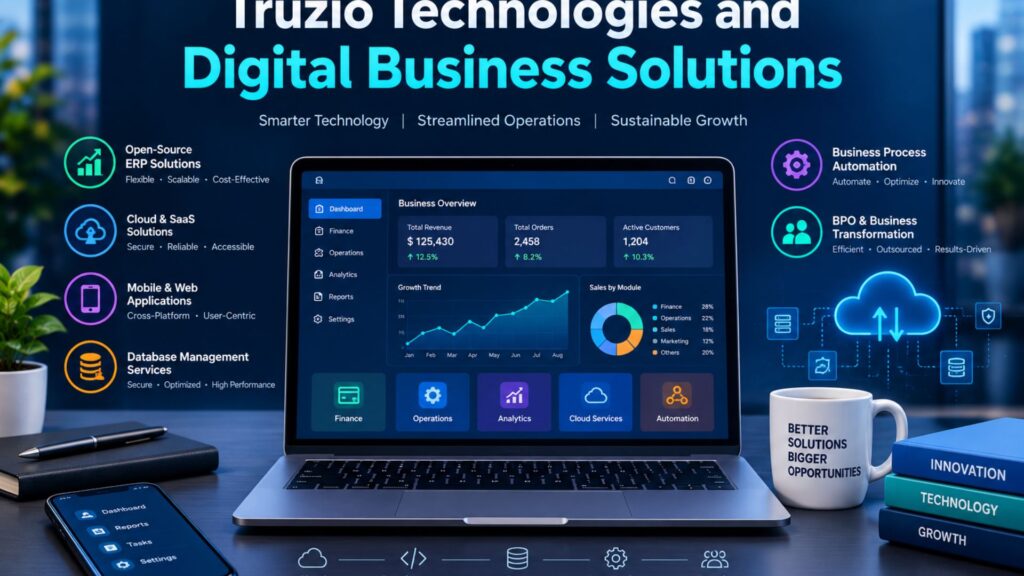
Truzio Technologies positions itself as a business transformation partner, not just a software vendor. According to its own company profile, the firm describes itself as a “leading business transformation expert group” built around open-source ERP deployment (Datanyze). That’s a fairly ambitious label for a small, India-based firm, so it’s worth treating the marketing language with a bit of healthy skepticism.
What does seem consistent across its public listings is a focus on helping companies that have already committed to a packaged ERP solution get more value out of it. The team claims over a hundred years of combined experience across its staff a common industry shorthand for “we’ve been doing this a while,” rather than a literal single-company track record.
Truzio as a Business Transformation Provider
The company frames its work around aligning information technology with actual business outcomes. In plain terms, that means it doesn’t just install software; it tries to connect that software to results you can measure, like faster order processing or fewer manual errors.
Core Purpose and Business Approach
Truzio Technologies’ stated purpose centers on enterprise technology that’s flexible and affordable. Its technology consulting work leans heavily on open-source tools instead of costly proprietary licenses, which keeps upfront costs lower for smaller clients.
What Services Does Truzio Technologies Offer?
Public listings describe a service mix that includes IT services, consulting, outsourcing, and technical support, plus mobile app development and business process outsourcing (Facebook). It’s a fairly typical small-agency service list: build it, deploy it, and stick around to fix it when something breaks.
Read More About: Bobbilou05 in the Digital World: Meaning, Identity & Online Influence in 2026
What Is Truzio ERP?
Truzio ERP is the company’s core product: a “license-free” ERP software application built on open-source technology. Instead of paying recurring license fees the way you would with big-name ERP vendors, you get the software itself for free and pay for implementation, customization, and support instead.
That pricing model isn’t unique to Truzio it’s the same logic behind other open-source ERP platforms like Tryton and Odoo. What matters more than the “free” label is how well the implementation team configures the system for your specific business processes, because a badly configured free ERP can cost you more in the long run than a well-configured paid one.
How Truzio ERP Supports Business Operations
The platform is meant to sit at the center of daily operations, touching finance, inventory, and workflow management. Practically speaking, this means one system tracks data instead of five disconnected spreadsheets fighting for accuracy.
Cloud and On-Premise Deployment
Truzio ERP reportedly supports both cloud deployment and on-premise deployment, giving businesses a choice based on their security needs and budget. Companies handling sensitive records often prefer on-premise deployment, while smaller teams usually lean toward cloud solutions for lower maintenance overhead.
Mobile Business Operations
Mobile ERP access lets staff check inventory, approve requests, or pull reports without being tied to a desk. It’s a small feature on paper, but it changes daily habits fast once people get used to it.
Open-Source ERP Approach
Truzio’s ERP practice is built using Python and PostgreSQL, a pairing that’s genuinely common across the open-source ERP world (RocketReach). Python handles the application logic, while PostgreSQL manages data management and storage a dependable, well-tested combination that a lot of developers already know how to work with.
How Truzio Works: Core Technology and Architecture
Think of an ERP platform like Truzio’s as a set of stacked layers, each handling a different job. That structure keeps the system from turning into a tangled mess as a company adds more departments and processes over time.
Here’s a simple breakdown of how those layers typically divide responsibility:
| Layer | What It Handles | Why It Matters |
| Data and Information Layer | Collects and stores records | Creates one source of truth |
| Business Process Automation | Runs repetitive tasks automatically | Saves staff time |
| Intelligence and Decision Support | Analyzes patterns in the data | Supports smarter calls |
| System Integration | Connects to outside tools | Avoids data silos |
Data and Information Layer
This is the foundation. It pulls information from different parts of the business sales, inventory, HR into one place, so system integration doesn’t rely on people manually copying numbers between tools.
Business Process Automation
Workflow automation takes routine tasks off someone’s plate. Invoice approvals, stock updates, and order confirmations can all run automatically once the rules are set.
Intelligence and Decision Support
This layer turns raw numbers into something a manager can actually use, flagging trends or risks before they become expensive problems.
System Integration and Connectivity
Data integration across tools accounting software, CRMs, e-commerce platforms keeps everything talking to each other instead of operating in isolated pockets.
Core Capabilities of Truzio-Style Business Solutions
Most ERP implementation projects, whether from Truzio or a competitor, revolve around a handful of core capabilities. Knowing what these are helps you evaluate any ERP vendor, not just this one.
You’re generally looking at five things: automation, analytics, scalability, integration, and customer experience tools. Each pulls its weight differently depending on your industry.
Business Process Automation
Automating repetitive tasks is usually the first win a company notices after ERP implementation. It’s the difference between someone manually re-entering the same order three times and the system doing it once, correctly.
Real-Time Analytics
Real-time analytics means dashboards that update as transactions happen, not once a month during a reporting cycle. That immediacy matters most in fast-moving sectors like retail or logistics.
Cloud-Based Scalability
Scalable systems let a business add users or locations without a full infrastructure overhaul. Cloud computing makes that expansion mostly a matter of a few settings, not new servers.
Enterprise Integration
Enterprise integration connects an ERP to the other software a company already relies on, so legacy tools don’t need to be ripped out and replaced overnight.
Customer Experience Optimization
Better internal data usually means better external service, too. Customer experience improves when staff can pull up accurate order history instantly instead of putting a caller on hold.
Technologies Behind Truzio Solutions
The technology stack behind any modern ERP shapes what it’s capable of. A handful of specific technologies show up again and again across this space.
Below is a quick look at the main categories and what they typically contribute.
Artificial Intelligence and Machine Learning
Artificial intelligence and machine learning help predict demand, flag anomalies, and suggest next steps based on historical patterns rather than guesswork.
Cloud Computing
Cloud computing gives businesses remote access and lower hardware costs, though it does shift some security responsibility onto the provider you choose.
IoT Connectivity
IoT connectivity matters most in manufacturing and logistics, where sensors track equipment condition or shipment location in real time.
Cybersecurity Technologies
Cybersecurity protects the data flowing through these systems. Encryption and access controls aren’t optional extras anymore; they’re baseline expectations for any serious ERP setup.
Why Digital Transformation Matters in 2026
Digital transformation isn’t a buzzword you can shrug off anymore. Markets move fast, and companies still running on spreadsheets and disconnected tools fall behind quickly once a competitor automates the same work.
Four pressures drive most of this urgency: market competition, the demand for instant decisions, exploding data volumes, and the sheer impossibility of scaling manual processes.
Rising Business and Market Pressure
Product cycles shrink every year, and businesses that can’t adapt their operations just as fast tend to lose ground to ones that can.
Demand for Real-Time Decision-Making
Waiting for a monthly report used to be normal. Now, teams expect answers the same day, sometimes the same hour.
Growing Data Volumes
The sheer amount of business data keeps climbing, and without a system to organize it, that data becomes noise instead of insight.
The Need for Automation
Manual processes simply don’t scale. At some point, hiring more people to do repetitive work costs more than automating it.
Business Benefits of Digital Transformation
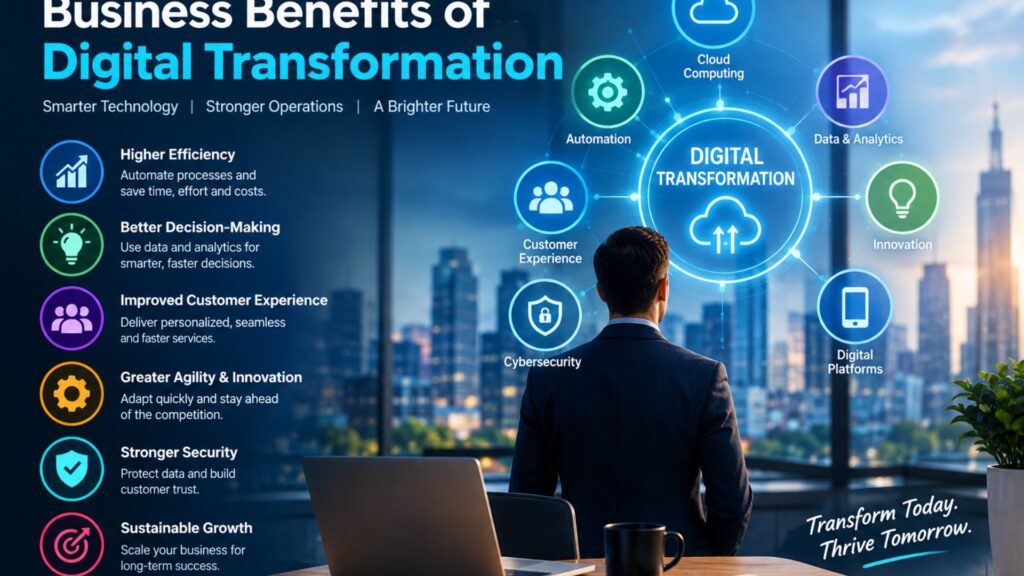
When digital transformation goes well, the payoff shows up in a few predictable places: efficiency, speed, cost, customer experience, and agility.
None of these benefits arrive instantly, though. They build gradually as automation and better data replace guesswork across departments.
Improving Operational Efficiency
Operational efficiency climbs when repetitive tasks stop eating up staff hours that could go toward higher-value work.
Faster Business Decisions
Leaders act faster when the numbers are already in front of them instead of buried in last week’s spreadsheet.
Reducing Operational Costs
Fewer manual errors and less duplicated effort translate directly into lower operating costs over time.
Improving Customer Experience
Faster response times and fewer mistakes make customers notice usually in a good way.
Increasing Business Agility
A business that can shift direction quickly has a real edge when market conditions change without warning.
Industry Applications of Truzio-Style Solutions
ERP and automation tools like the ones Truzio Technologies builds show up differently depending on the industry. Here’s how that typically plays out.
Healthcare
Hospitals and clinics use these systems for patient record management, appointment scheduling, and predictive resource planning.
Financial Services
Banks and fintech firms lean on automation for fraud detection, risk analysis, and compliance reporting.
Retail and E-Commerce
Retailers use business intelligence tools for inventory prediction, personalized recommendations, and customer segmentation.
Manufacturing
Factories rely on predictive maintenance and production tracking to avoid costly downtime.
Logistics
Shipping and delivery companies use route optimization and real-time tracking to keep goods moving efficiently.
Truzio and Mobile Business Operations
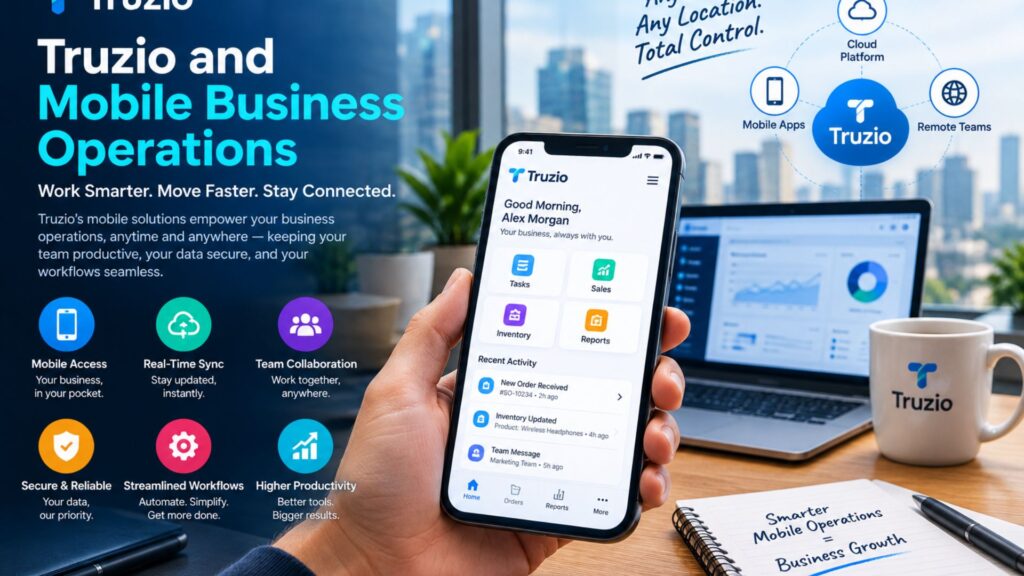
Mobile access has quietly become one of the most requested ERP features, and it’s easy to see why once your team gets used to it.
Staff increasingly expect to check numbers and approve requests from their phones, not just from a desktop at the office.
Supporting Remote Access
Remote teams need the same visibility as in-office staff, and mobile ERP access closes that gap.
Connecting Teams and Business Systems
Mobile tools keep field staff and office teams working off the same data, rather than syncing up hours later.
Managing Operations Across Devices
Whether it’s a phone, tablet, or laptop, the system should behave consistently, so nobody loses functionality switching devices.
Challenges of Digital Transformation
Digital transformation projects don’t always go smoothly, and it’s worth knowing the common failure points before you commit budget to one.
Legacy Systems
Old software slows integration down and often can’t talk to newer tools without custom workarounds.
Employee Resistance
People resist new tools when they don’t understand why the change is happening. Communication matters as much as the software itself.
Data Security Risks
More connected systems mean more entry points for attackers, which is exactly why cybersecurity planning has to happen early, not as an afterthought.
Integration Challenges
Connecting a new ERP to a decade-old accounting tool rarely goes perfectly on the first try.
Best Practices for Implementing Digital Transformation
A few practical habits separate successful rollouts from expensive failures.
Start With Clear Business Goals
Define what success actually looks like before you sign a contract, not after.
Focus on High-Impact Areas
Don’t try to transform everything at once. Pick the process causing the most pain and start there.
Train Employees Early
Training before launch, not after, dramatically improves adoption rates.
Monitor Performance Continuously
Track metrics like process speed and user adoption after go-live, not just during the sales pitch.
Security and Governance in Truzio Systems
Security sits at the center of any serious ERP conversation, and it deserves more than a passing mention.
Data Protection
Data validation and encryption keep sensitive records accurate and safe from tampering.
Access Control
Role-based permissions make sure staff only see the data relevant to their job, nothing more.
Compliance and Governance
Regulatory compliance varies by industry, so governance policies need to match the specific rules a business operates under.
Cybersecurity Best Practices
Regular audits, updated software, and staff training all reduce the odds of a costly breach.
Read More About: Droven io Best Tech Tools for Developers (2026): Complete Guide
Is Truzio Right for Your Organization?
Whether Truzio Technologies fits your needs depends heavily on your size, budget, and appetite for working with a smaller, less globally recognized vendor.
When a Business May Benefit
Open-source ERP tends to suit small and mid-sized businesses that want lower licensing costs and don’t need enterprise-scale support contracts.
Factors to Consider Before Implementation
Ask about support availability, customization costs, and how large the vendor’s team actually is before committing.
Potential Limitations
Smaller vendors sometimes have limited public track records, so due diligence matters more than it would with a major, well-documented ERP brand.
Digital Transformation Trends Shaping 2026
A few trends are shaping how businesses approach transformation projects this year.
AI-Driven Business Operations
Artificial intelligence increasingly handles decisions that used to require a human review step.
Hyperautomation
Companies now combine AI, business process automation, and analytics to automate entire workflows end-to-end.
Low-Code and No-Code Platforms
Teams build internal tools faster without needing deep coding skills, speeding up small process fixes.
Real-Time Data Systems
Instant dashboards are replacing the old monthly reporting cycle across most industries.
The Future of Smart Business Platforms
Looking ahead, enterprise systems are trending toward deeper automation and tighter AI integration.
AI-Powered Enterprise Systems
Expect more decision-making handled by algorithms, with humans stepping in mainly for exceptions.
Increasing Business Automation
Automation will likely expand into areas still handled manually today, like complex approvals and vendor negotiations.
Connected Digital Ecosystems
Digital platforms will increasingly talk to each other by default, reducing the manual integration work businesses deal with now.
Frequently Asked Questions
What Is Truzio?
Truzio most commonly refers to Truzio Technologies, a Hyderabad-based open-source ERP and IT services company founded in 2012.
What Is Truzio Technologies?
It’s an enterprise services firm offering ERP customization, consulting, outsourcing, and technical support built around open-source software.
What Is Truzio ERP?
Truzio ERP is the company’s core enterprise solutions product, a license-free ERP application built with Python and PostgreSQL.
Does Truzio Use Cloud Technology?
Public listings describe support for both cloud and on-premise deployment, giving businesses flexibility based on their infrastructure needs.
Is Truzio a Business Transformation Platform?
Truzio Technologies markets itself that way, though it’s a small firm, so verify current capacity and support directly before committing.
Are Truzio and Truzio Technologies the Same?
Generally, yes, though the name “Truzio” also belongs to Truzio.co, an unrelated data validation service based in London. Always confirm which one you’re researching.
Why Is Truzio Trending Online?
Honestly, there’s no strong evidence of a major surge in real popularity. The apparent “trend” more likely comes from search confusion between multiple unrelated businesses sharing the same name, plus a wave of generic content published about digital transformation platforms using the name loosely.
Conclusion
Truzio isn’t one tidy brand story, it’s at least two separate businesses wearing the same name. Truzio Technologies focuses on open-source ERP and IT consulting out of Hyderabad, while Truzio.co handles data validation from London. If you’re evaluating either one for your business, verify current details directly with the company rather than relying on secondhand summaries, since small vendors’ public information can get outdated fast.






2 Comments